Please call 1-800-794-1989 or use the SmartHub mobile app. To talk to a person, press zero.

For most of us, electricity is something we don’t think about until the lights flicker or the power goes out. Behind that everyday reliability is a complex network of poles, lines, and equipment that must be carefully maintained across thousands of miles, often stretching across private property.
At FreeState Electric Cooperative, ensuring that system runs safely and reliably is not just a job. It’s a shared responsibility between the cooperative and its members.
One of the most important — and sometimes misunderstood — parts of that relationship is access to member property.
SHARED RESPONSIBILITY
Unlike investor-owned utilities, electric cooperatives are member-owned. That means every FreeState member has a stake in the system and a role in supporting it.
Part of that role includes providing the cooperative with the ability to access property when necessary to build, maintain and protect electrical infrastructure.
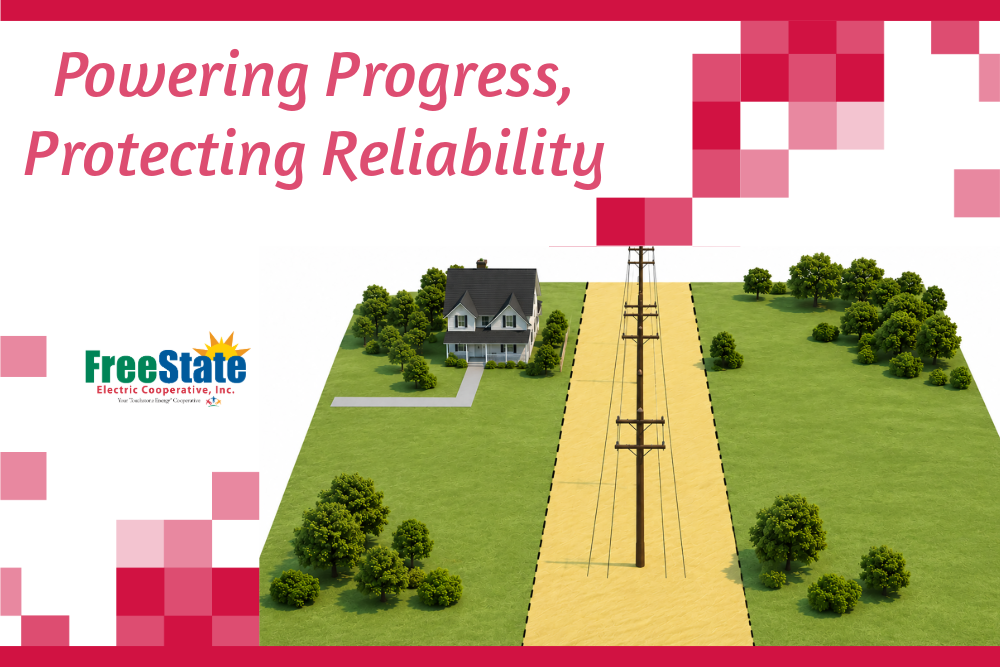
Under FreeState’s Rules and Regulations, members agree to provide rights-of-way and allow access for activities such as constructing lines, trimming trees, inspecting equipment, reading meters and making repairs.
Chris Parr, CEO of FreeState Electric Cooperative, says this is fundamental to how the cooperative serves its members:
“Reliable service doesn’t happen by accident, said Parr.“It requires ongoing maintenance and the ability for our crews to safely reach the equipment that powers our communities. Access is a critical part of that.”
WHY ACCESS IS ESSENTIAL
Electric systems are interconnected, and a single issue in one location can quickly affect many others. A tree growing too close to a line, a damaged pole or a malfunctioning piece of equipment can disrupt service far beyond one property.
That’s why FreeState must be able to act quickly, and sometimes with little notice, when maintenance or repairs are needed.
Members are required to provide full and free access to cooperative employees and authorized contractors for any work related to electric service. This ensures crews can respond efficiently, especially during emergencies.
“When there’s an outage or a safety concern, every minute counts,” explained Zach Sterling, FreeState’s chief operations officer, “If our crews can’t get to the problem quickly, it can extend outages or create additional risks. Access allows us to do our jobs safely and restore power as quickly as possible.”
THE ROLE OF EASEMENTS AND KANSAS LAW
The cooperative’s right to access property is supported not only by member agreements, but also by Kansas law.
Under state statute, if electric lines have been continuously maintained on a property for more than two years, legal challenges to their presence are barred. This helps ensure long-term stability for the electric system and prevents disruptions that could impact entire communities.
For members, this means that infrastructure you see on or near your property is often part of a longstanding, legally recognized system designed to serve many homes and businesses.
“These laws are in place to protect the reliability of the grid,” Parr noted. “They ensure that infrastructure serving entire neighborhoods can continue to operate without interruption.”
WHAT MEMBERS SHOULD KNOW
While the cooperative maintains its equipment, members have important responsibilities as well.
FreeState’s Rules and Regulations outline several key expectations:
- Members must not interfere with cooperative equipment or attach anything to poles or lines without permission.
- Personal electrical installations must meet safety codes and be properly maintained.
- Members should avoid building or placing objects too close to electric facilities.
- Any hazards, damage or unusual conditions should be reported immediately.
Members are also responsible for protecting cooperative property located on their premises. Damage caused by tampering, misuse or accidents may result in repair costs being billed to the responsible party.
These rules are not just administrative. They are critical for the safety of our employees and the general public.
SAFETY COMES FIRST
Electric infrastructure is powerful and potentially dangerous. Maintaining safe conditions around electrical equipment protects not only cooperative crews but also members, their families and their property.
Obstructed access, unauthorized modifications or unsafe installations can create serious hazards. In some cases, the cooperative may suspend service if conditions are deemed dangerous to people or the system.
Sterling emphasizes the importance of prevention: “We’d much rather prevent a problem than respond to one,” he said. “Clear access and safe conditions help us identify issues early and keep everyone out of harm’s way.”
A POWERFUL PARTNERSHIP
At its core, the relationship between FreeState and its members is a partnership. The cooperative provides reliable electric service, and members support that mission by allowing access and maintaining safe conditions on their property.
This partnership is what allows FreeState to respond to storms, maintain infrastructure and plan for future growth, all while keeping costs reasonable and service dependable.
“Everything we do is about serving our members,” Parr concluded. “When members understand why access is important, it strengthens the entire cooperative and helps us deliver on our promise of reliable power.”
Access to member property is not about overreach or creating problems with property owners. It’s about reliability, safety and service to the entire distribution system.
By working together the system stays strong, and the cooperative continues to serve generations to come.
If you have questions about easements, access or your responsibilities as a member, FreeState encourages you to reach out. Understanding how the system works is one of the best ways to support the grid, as well as your neighbors who depend on it every day.
This content was featured in the July 2026 Kansas Country Living Magazine.